
How to Choose Ethical Gems for Custom Jewellery
When you’re commissioning a piece of custom jewellery, choosing the gemstone is usually one of the most exciting parts. Colour, sparkle, shape, rarity … I can happily disappear down a gemstone rabbit hole for hours! But increasingly, my clients want to know something else too: where did this gemstone come from? For me, that question is every bit as important as how beautiful the stone is.
I love jewellery with a story, and some of the gemstones I source are so traceable that I can tell you where they were discovered, when they came out of the ground and sometimes even show you photographs of the rough crystal before it was cut and polished.
There’s something rather magical about knowing the journey your gemstone has taken before becoming part of a piece of jewellery that has been designed especially for you.
So, if responsible sourcing matters to you, how do you choose ethical gemstones for a bespoke piece of jewellery?
What is an ethical gemstone?
Things become slightly complicated straight away - There isn’t one universal label that magically makes a gemstone “ethical”.
Responsible sourcing can involve lots of different considerations: the working conditions of the people mining the gemstone, fair pay, child labour, environmental impact, health and safety, the journey the gemstone takes through the supply chain and whether money generated by mining benefits the communities where the gems are found.
International jewellery industry guidance therefore tends to focus on transparency and due diligence throughout the supply chain, rather than simply describing one particular type of gemstone as ethical.
And, of course, everyone has slightly different priorities.
For one person, supporting small-scale mining communities might be particularly important. Someone else may prioritise environmental impact, while another client may be most concerned about having a completely traceable gemstone.
That’s why I prefer to talk about responsibly sourced and traceable gemstones rather than pretending there is one perfect answer.
1. Look for gemstones with provenance
Provenance is one of my favourite words when it comes to jewellery. It simply means knowing the history and origin of something.
With gemstones, the more information we have about where a stone originated and how it travelled from mine to ‘mine’, the more informed we can be about our choice.
Some coloured gemstones have remarkably short supply chains. A gemstone may pass from a miner to a specialist gem dealer, then to a cutter and ultimately to a jeweller.
Others may travel through numerous dealers and countries before reaching their eventual owner.
Neither automatically tells us whether a gemstone has been responsibly sourced, but greater transparency makes it much easier to ask the right questions about its journey.
This is one of the reasons I particularly enjoy sourcing unusual gemstones for bespoke jewellery commissions. Sometimes we can find a stone with a wonderfully detailed history attached to it.
Instead of simply owning “a sapphire”, you might own your sapphire, with its own origin and story.
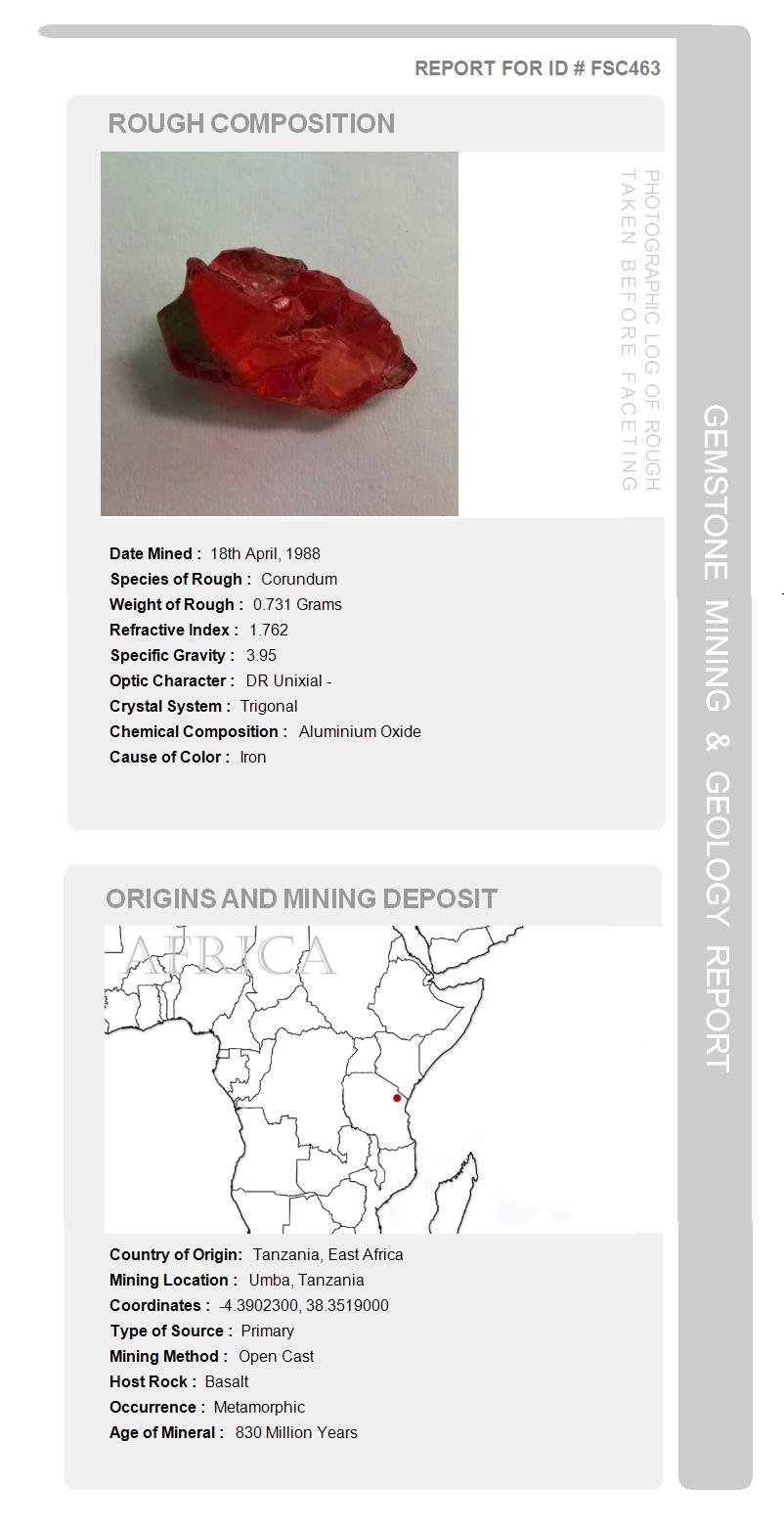
A Mining Report for one of my sapphires
2. Ask about the gemstone’s supplier
A beautiful gemstone can have passed through many hands before it reaches a jeweller. So one of the most important parts of responsible sourcing is having trusted suppliers.
I work with specialist gemstone dealers in the UK and overseas with whom I can discuss the provenance, treatments and sourcing of individual stones.
When I’m looking for a gemstone for a custom jewellery commission, I’m not simply looking for the right number of carats.
I’m looking at the whole stone.
Is the colour spectacular?
Does it have character?
Is it suitable for the jewellery we're designing?
Has it been treated?
Where did it come from?
What do we know about its journey?
For me, those details make choosing a gemstone much more interesting.
3. Learn about artisanal mining
80% of coloured gemstones originate from artisanal and small-scale mining, rather than the enormous industrial mines people often picture when they hear the word “mining”.
And this introduces another important point: mining itself isn't automatically unethical.
Responsible small-scale mining can provide employment, income and infasctructure like healthcare and eduction for individuals, families and communities in gemstone-producing regions.
Simply choosing a non-mined alternative therefore doesn't necessarily solve every ethical question. Removing demand for responsibly mined natural gemstones can also remove livelihoods from the communities that depend upon them.
Ethical sourcing isn’t a straight line, what matters is understanding as much as possible about the supply chain and making a choice that reflects your own values.
4. Find out whether your gemstone has been treated
Another question worth asking is whether a gemstone has undergone any treatment.
Many perfectly genuine natural gemstones are treated to improve their colour or clarity. Heat treatment, for example, has been used for centuries and is extremely common with gemstones such as sapphires.
Other treatments can include oiling, irradiation, dyeing and fracture filling.
A treated gemstone isn't necessarily unethical — or undesirable — but any treatment should legally be disclosed as it can affect the value of a gemstone and, in some cases, the way that gemstone needs to be looked after.
I love sourcing beautiful untreated gemstones where possible, but there are also many spectacular responsibly sourced treated stones that make wonderful jewellery.
The important thing is honesty - You should know what you're buying.
5. Ask for an independent gem report where appropriate
For important or valuable gemstones, an independent gemmological report provides another layer of confidence.
Depending upon the gemstone and the laboratory, a report can confirm information such as:
whether the gemstone is natural or laboratory-created
gemstone variety
detectable treatments
its weight and measurements
and, in some cases, an opinion on geographical origin.
It's worth making an important distinction here.
A gemmological report isn't automatically proof that the gem is ethical. Its purpose is primarily to establish what the gemstone is and provide independent information about it.
Some reports aren’t worth the paper they’re printed on! There are a lot of fakers out there, particularly when buying gems in or near mining areas. A report from a globally recognised Lab is the only way to truly know about a gem.
Good provenance, a good lab report and a transparent supply chain, it can help us build a much clearer picture of the gemstone's story.
For significant stones I source for bespoke jewellery, I like having the additional reassurance of a Lab report.

A Gem Report
6. Consider a pre-loved gemstone
Sometimes the most ethical gemstone is one that already exists. I regularly work with clients who have gemstones sitting unworn in jewellery boxes.
Perhaps it is Granny's diamond. An engagement ring that no longer suits its owner. A beautiful sapphire hidden inside a rather dated 1980s cluster ring. Or an inherited piece which has enormous sentimental value but isn't something you would ever actually wear.
Rather than buying another gemstone, we can carefully remove the existing stones and create something completely new around them.
I adore these projects because we're not only reusing precious materials — we're adding another chapter to the jewellery's story.
A gemstone that belonged to one generation can become an engagement ring, pendant or pair of earrings for the next. That's pretty epic!
7. Natural or lab-grown: which is more ethical?
This is another question without a one-word answer.
Laboratory-grown gemstones can reduce some of the impacts associated with mining, but creating gemstones in a laboratory requires huge energy and resources too. The environmental impact will therefore depend partly upon how and where they are manufactured and the energy used.
Natural gemstones, meanwhile, support an enormous global network of miners, cutters, polishers, dealers and their communities.
So I wouldn't automatically describe either option as the ethical choice. I'd rather look at the individual stone, its provenance and the information available about the people and processes behind it. And then let you decide which factors matter most to you.
8. Choose the right gemstone for the jewellery you're creating
Ethics is important, but there is one more thing to consider when choosing your gemstone - It needs to be right for the job.
A gemstone destined for an engagement ring that will be worn every day needs to withstand considerably more knocks and bumps than one being set into an occasional pendant.
Sapphire, ruby and spinel, for example, can be excellent choices for rings because of their hardness and durability. Other beautiful gemstones may need a little more protection or might be better suited to earrings or necklaces.
When I design a bespoke piece, I consider the gemstone and the jewellery together. The setting, metal, stone and proportions all need to work as one design.
Because there's little point finding the world's most fabulous ethical gemstone if the jewellery isn't designed to let you enjoy it for years to come.
Choosing a gemstone with a story
For me, this is really what ethical gemstone jewellery comes down to.
Ask questions. Be curious. Look beyond the sparkle.
I don't think responsible jewellery should be about making people feel guilty about what they buy. It should be about giving you enough information to make a thoughtful choice. And custom jewellery gives us a wonderful opportunity to do exactly that.
Rather than simply choosing something from a cabinet, we can start with an idea. We can search for the right gemstone, learn about its provenance and create a piece of jewellery around both you and its story.
Sometimes I can even show you what your gemstone looked like before anyone had polished a single facet onto it.
And I think knowing that little piece of rock has travelled from the earth, through the hands of miners, cutters and craftspeople before becoming a jewel designed specifically for you makes it infinitely more fascinating.
Are you looking for an ethical gemstone for a bespoke jewellery commission?
If you have a particular colour, gemstone, occasion or idea in mind, get in touch.
I can help you source a beautiful responsibly sourced gemstone and then design a completely unique piece of jewellery around it — whether it's an engagement ring, anniversary present, milestone birthday or simply something extraordinary that you've always wanted.
Because the best jewellery doesn't just look beautiful.
It has a story worth telling.